


The definition of “home” has undergone a profound transformation. No longer just a functional shelter or a showcase of visual excess, the contemporary home has evolved into a wellbeing ecosystem—a sanctuary designed to support daily routines, remote work, physical health, and mental tranquility.
If you are planning to build, renovate, or redesign, here are the defining residential architecture and design trends shaping homes today
1. The Evolution of Minimalism: “Warm Minimalism” & “Minimaluxe”
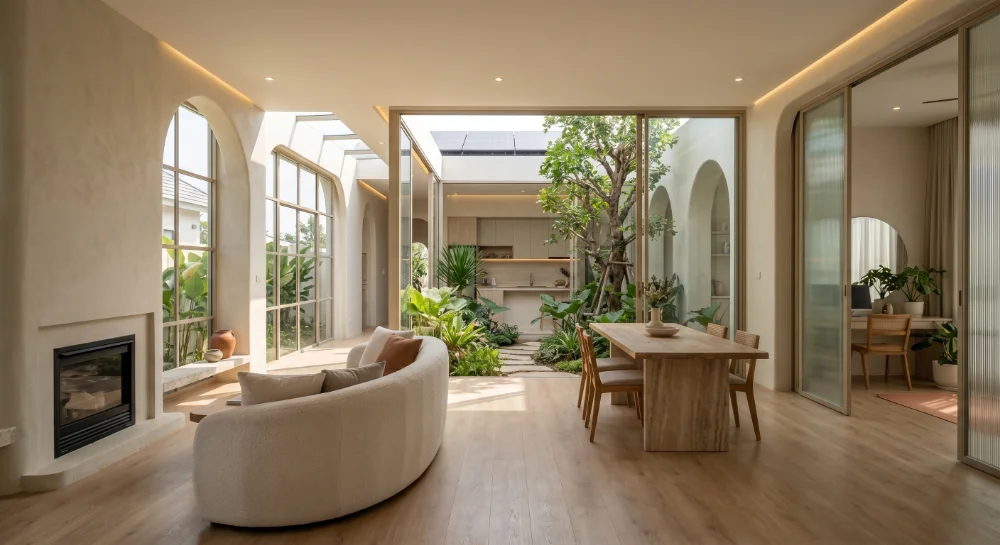
The era of stark, cold, gallery-like white interiors has given way to a softer aesthetic known as Warm Minimalism or Minimaluxe. This trend focuses on simplicity but elevates it through comfort and material richness. Sharp angles are being replaced by organic curves and softly sculpted forms—such as arched openings and rounded furniture. The color palette has shifted to inviting earth tones, including cream, beige, taupe, mushroom, and terracotta, layered with rich textures like natural timber, stone, lime plaster, and tactile textiles.
2. Biophilic Design and Seamless Indoor-Outdoor Flow
Integrating nature into the home is no longer optional; it is fundamental to modern architectural layouts. Biophilic design emphasizes a physical and visual connection to the natural environment. This is achieved through large, strategically oriented windows and skylights that flood spaces with natural light, internal courtyards, and planted terraces. There is a strong preference for honest, sustainable materials and non-toxic finishes (such as low-VOC paints) that promote clean indoor air quality and emotional calmness.
3. Highly Adaptable Layouts: “Zoned” Open Concepts and Flex Rooms
While open-plan living remains popular, lessons from hybrid work and multi-generational living have introduced the “Zoned” Open Concept. Instead of completely wall-free spaces, architects are using sliding panels, pocket doors, or subtle changes in floor levels and materials to define distinct zones without sacrificing airiness. Additionally, the Flex Room has become the ultimate home workhorse—a versatile space that can easily transition from a home office or yoga studio into a guest room or a suite for aging parents.
4. The Rise of “Modern Heritage” and Character-Rich Styles
Homeowners are increasingly moving away from cookie-cutter modern designs toward homes with character and a sense of permanence. The Modern Heritage or New Transitional style is highly favored, blending timeless, traditional architectural silhouettes (such as classic gables or regional cultural elements) with clean, modern edits like steel-framed windows and simplified trim. It delivers a look that feels grounded in history yet thoroughly fresh and current.
5. Invisible Technology: The “Quiet” Smart Home
Smart home technology is no longer flashy or intrusive. Today’s trend points toward Quiet Integration, where AI-assisted systems, automation, and sensors are recessed and seamlessly blended into the architecture. The focus has shifted from high-tech novelty to energy efficiency and wellness—featuring smart climate control, predictive maintenance, circadian lighting systems that mimic daylight, and integrated solar energy storage to create resilient, low-energy homes.
Conclusion: Current housing trends prove that successful residential design is not about chasing short-lived fashion. Instead, it is about authenticity, space efficiency, and human-centric design. A home that endures is one built with durable materials, thoughtful spatial volume, and a deep respect for the well-being of those who live within its walls.